ELECTROMECHANICAL ENGINEERING

BEng (Hons)


Accredited by the University of Warwick

Award

BEng

Course Level

Undergraduate

Duration

3 years FT/4.5 years PT

Entry

September, February

Fees

View fees

Department of Engineering
Discover more at our next open day

Saturday 06 December 2025

Join an open day

Why should I choose this Electromechanical Engineering degree?

  • PRACTICAL APPLICATION – Get hands-on experience studying in our cutting-edge engineering facilities
  • ENRICHMENT – Go on visits to manufacturing and engineering sites with industry partners such as Shell Energy, Warwick Manufacturing Group and the University of Warwick
  • EXPERT TUITION – Learn from experienced, highly-experienced lecturers with a wealth of knowledge from working in the engineering industry, as well as leading guest speakers

19% of all UK employees work in the engineering sector*

*EngineeringUK

200,000 engineers are urgently needed to meet UK demand* 

*Prospects.ac.uk

Our Electromechanical Engineering BEng (Hons) degree combines the disciplines of electrical and mechanical engineering to prepare you for an exciting career.

In today's technology-driven world, electromechanical engineers are at the forefront of designing and developing complex systems that integrate electrical and mechanical components.

 Our electromechanical engineering course equips you technical knowledge and practical skills to excel in diverse industries, from robotics and automation to renewable energy and manufacturing.

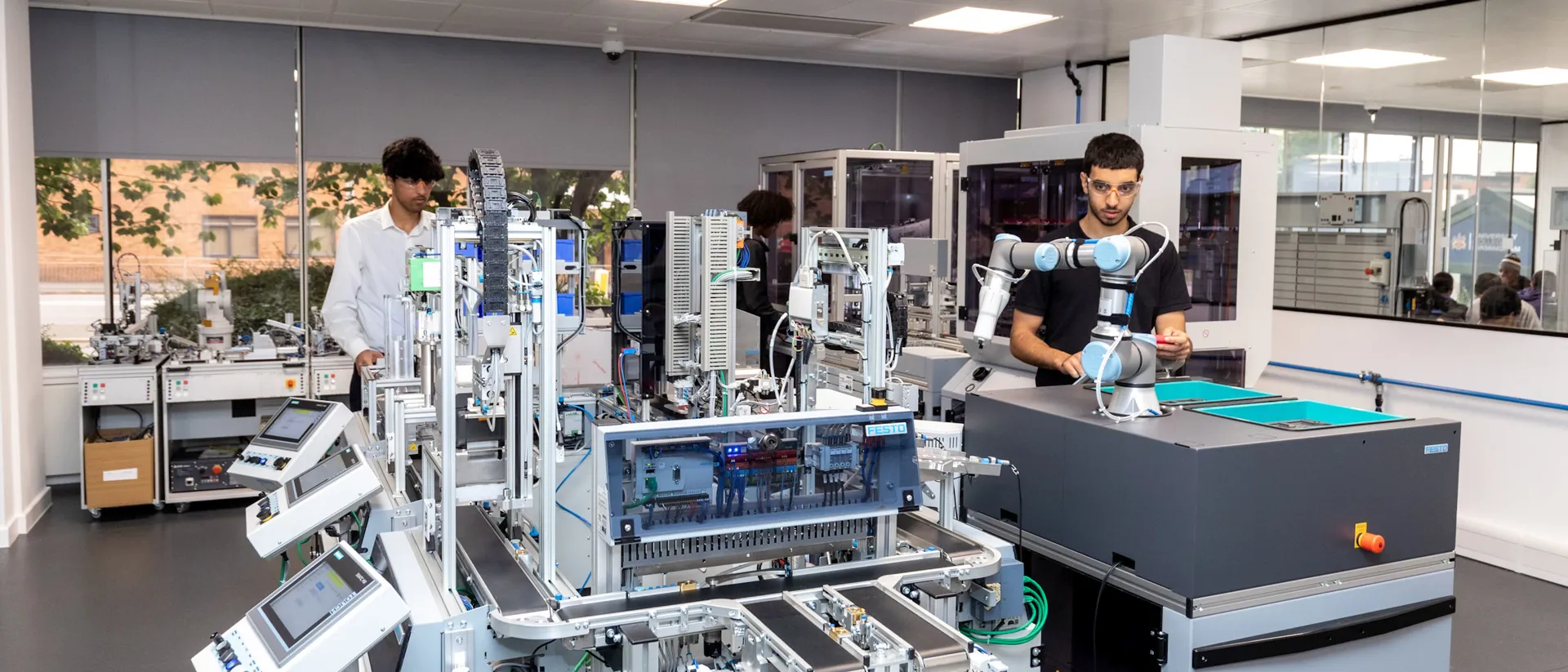
By combining electrical and mechanical engineering principles, you'll gain the expertise to design, develop and maintain electromechanical systems across various industries. Our facilities are totally up-to-date for Industry 4.0, while the hardware and software is the same used in industry.

On graduation, you will be an expert in engineering disciplines, in the use of simulation software and computer control of automated operations, ready for industry. We also make sure you are skilled in independent learning, so you can keep pace with developing new technologies throughout your career.
Our facilities

Engineering students gain hands-on experience of programming robots and controllers in our state-of-the-art industrial manufacturing cell facility, plus you will use all our modern laboratories for practical work in electrical power, electronics and control, fluid mechanics, mechanical principles and materials testing. 

• Training rigs
• Production line technology
• Industry 4.0 rigs
• Process manufacturing training equipment
• Hydraulics
• Pneumatics
• Renewable energy simulators
• Control engineering rigs
• Cyber physical system
• Mechatronics automation
• PLCs
• Fluid dynamics software
• MATLAB design software
• Enhanced IT facilities

GBSIoT facilities

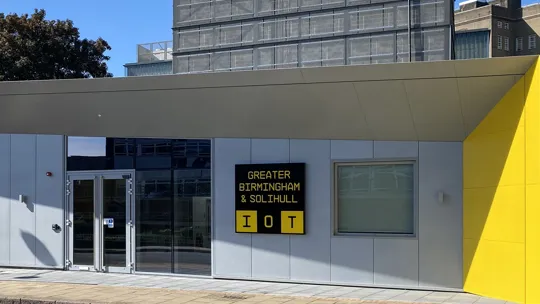
Our students gain access to the GBSIoT Hub — a state-of-the-art facility in central Birmingham, including Europe’s largest Cyber Physical Manufacturing Rig, hybrid classrooms and hot-desk spaces.

Find out more

“Access to Festo equipment gives degree students the chance to practise real-world engineering and automation skills, mirroring industry environments. With expert training provided by Festo specialists, students gain confidence, bridge theory with practice, and prepare for professional careers.” - NEEDS APPROVAL

Babak or Sameer Didactic services

Course breakdown

  • Year 1
  • Year 2
  • Year 3

Year 1

Engineering Maths

Acquire the vital mathematical toolkit essential for success across your entire BEng program and future engineering career. This module provides a thorough understanding of key principles used to model and solve complex engineering challenges. Study practical applications of matrix algebra, probability, statistics, vectors, and sinusoidal functions. Master advanced techniques in calculus and numerical methods for analytical problem-solving in real-world engineering situations.

Mechanical Principles

Establish the essential underpinning science of all machines by gaining crucial knowledge of mechanical principles. Investigate the behavioural characteristics of static, dynamic, and oscillating engineering systems. Learn to solve complex problems involving shear forces, bending moments, torsion, and conservation of energy principles. Apply these principles to analyse power transmission systems, designing the physical products and systems of tomorrow.

Electrical Principles

Unlock the fundamental knowledge of electrical circuits and components necessary for electro-mechanical devices. Dive into core concepts like Ohm's Law, Kirchhoff's Law, DC/AC circuits, and essential circuit theorems. Learn to solve complex problems and examine circuit design using both simulation software and laboratory equipment. Build the essential technical foundation required for innovation in electrical and electronic engineering applications.

Electronics and Logic

Explore the basis of modern technology, focusing on analogue and digital semiconductor devices and logic systems. Study key components, including transistors, amplifiers, and operational amplifiers, alongside fundamental digital logic principles. Gain hands-on experience designing, simulating, and prototyping complex circuits using industry techniques. Master essential methods like Boolean Algebra and Karnaugh maps to design robust combinational and sequential logic systems.

CAD Design

Master Computer Aided Design (CAD), one of the most vital disciplines in modern engineering. Gain foundational and practical skills using industry-standard solutions to design complex electro-mechanical products. You will create intricate 3D solid models, fully working assemblies, electrical schematics, and detailed 2D drawings. Understand how CAD data serves as the critical virtual prototype in the end-to-end business process.

Software Applications

Accelerate innovation by mastering the industry software applications that optimise designs and virtually test products. Use industry-standard 3D software to perform basic Finite Element Analysis (FEA) and Computational Fluid Dynamics (CFD). Develop crucial programming skills using an industry-standard numeric computing platform (e.g., MATLAB or equivalent). Learn to deploy software tools to create program scripts, generate plots, and perform interactive computations for engineering analysis.

Year 2

Systems and Control Principles

Uncover the fundamental principles and objectives of control engineering, essential for operating complex systems. Develop mathematical models for physical systems, including electrical, mechanical, and thermal processes. Learn advanced techniques such as Bode plots and Nyquist plots for time and frequency response analysis and system stability. Gain practical expertise designing and tuning PID control systems using professional software tools like MATLAB.

Thermofluid Mechanics

Gain essential knowledge of fluid mechanics principles to predict and control fluid behaviour in diverse engineering applications. Study fundamental concepts including viscosity, Bernoulli's equation, laminar flow, and pressure loss in pipework. Analyse thermodynamics, applying the First and Second Laws to model various systems and heat engine cycles (e.g., Carnot, Otto). Master mathematical modelling techniques to calculate energy transfer, heat loss, and work done in thermodynamic systems.

Renewable Energy and Sustainability

Become a pivotal engineer in tackling global warming by studying efficient renewable energy use and sustainability. Gain a deep understanding of the three pillars of sustainability and the transition toward a global circular economy. Learn how engineering decisions impact business through Whole Life Cycle Analysis (LCA) and eco design principles. Evaluate energy production/consumption and appraise sustainable solutions through detailed product teardown and analysis.

Smart Manufacturing

Delve into the future of production by exploring Smart Manufacturing and the key principles of fully digitised factories. Study cutting-edge technologies like the Industrial Internet of Things (IIoT), Artificial Intelligence (AI), and digital twins. Identify how connectivity and data analytics optimise processes, allowing for predictive maintenance and enhanced environmental benefits. Analyse manufacturing processes (MPA) and prepare for the professional role of an engineer in the advanced smart factory environment.

Mechatronics Systems

Master mechatronics: the synergistic integration of mechanical, electrical, electronic, computer, and control engineering. Learn to adopt a holistic 'system level' view, breaking complex integrated systems into appropriate mechanical, electrical, and software components. Select suitable sensors, signal conditioning, processors, and actuators to achieve sophisticated functional goals. Gain expertise using industry-standard tools to model and simulate a complete mechatronic system before physical construction.

Virtual Engineering and Simulation

Explore the theory and practice of Virtual Engineering and Simulation to rapidly accelerate product innovation. Use industry-standard 3D software to develop and analyse electro-mechanical products using Finite Element Analysis (FEA) and Computational Fluid Dynamics (CFD). You will work in a group to solve a real-world engineering problem, applying design processes from conception to detailed prototype. Assess system performance and optimise kinematic operation by modelling complex engineering problems using powerful simulation software.

Year 3

Embedded Systems

Step into the pervasive world of embedded systems, the dedicated computing power behind our cars and offices. Engage in a hands-on project to design, build, test, and present an embedded system using an Arduino-compatible controller. You will learn structured software development, reading complex sensors, and controlling output devices like servo motors. Integrate your previous electronics and software knowledge to define and demonstrate a complete, stand-alone system.

Internet of Things Operation and Control

Take your skills to the next level by connecting electronic devices remotely in the fascinating and rapidly growing world of IoT. Analyse the core architecture of IoT systems, from the device layer to communication protocols and cloud applications. Implement and evaluate data storage in an IoT cloud to facilitate critical remote access and configuration of systems. Define, design, build, and demonstrate a complete, stand-alone IoT system ready to meet a given engineering specification.

Industry 4.0 Manufacturing

Explore Industry 4.0, the global digital transformation integrating automation and data exchange in modern manufacturing. Learn how to fully digitalise industrial environments, connecting engineering development, manufacturing, and the supply chain. Study cyber-physical systems, IIoT, and Smart Factories to optimise production and efficiency on a global scale. Develop practical skills by building a web-based application to sense, monitor, and control real-world systems.

Project Management

Acquire the crucial professional and leadership skills necessary to successfully run industrial projects in your engineering career. Study modern theories and methodologies (e.g., PRINCE2 and LEAN) and apply sustainable project management practices. Develop comprehensive project plans, including time scheduling (Gantt charts), cost control, and rigorous risk analysis. Participate in practical case studies to appraise team performance and master essential monitoring and project closure techniques.

Independent Project

Undertake a detailed, in-depth independent project on an electromechanical topic within your own field of interest. Consolidate your entire degree learning by researching literature, analysing a problem, and proposing innovative solutions. Develop crucial professional skills: project planning (SMART objectives, Gantt charts), risk analysis, and critical reporting. Demonstrate your ability to function as a professional engineer through comprehensive documentation and a final presentation.

The modules listed above for this course are regularly reviewed to ensure they are up to date and informed by industry as well as the latest teaching methods. On occasion, we may need to make unexpected changes to modules – if this occurs, we will contact all offer holders as soon as possible.

Entry requirements 

Entry requirements

88 UCAS points – 

A-levels: CCD (Engineering, Physics, maths ideally, but not mandatory),

BTEC: MMM (Including further maths unit),

T-level: Pass (core component grade C).

GCSE/IGCSE: Maths (9–4/A*–C) or Functional Skills Level 2.

Other Level 3 qualifications are also welcome.

EU/International Students

For entry requirements for EU and international students, please visit the Country Specific Information page.

Key information

Teaching and assessment

Teaching

A wide variety of teaching methods will be used to ensure you gain the appropriate skills and knowledge, including lectures, practical sessions, workshops, tutorials and group study sessions. Face-to-face classes will be combined with practical research activities in our state-of-the-art engineering facilities, while you will also conduct independent and online learning.

Assessment

Assessment occurs through a combination of assignments, projects and tests/exams, with a focus on the holistic development of practical, interpersonal and higher-level skills. Many modules will require a practical demonstration of skills, while others will require you to carry out your own research and analysis, working independently or as part of a team. Our assessments will focus on developing the skills required by a professional engineer – designing and demonstrating a product, delivering presentations and technical report-writing, aimed at technical and non-technical audiences to broaden your range of skills.

You will also need to commit around 20 hours per week for individual study time.

Estimated breakdown of assessment for this course:

  • Coursework – 70%
  • Practical assessment – 25%
  • Written examinations – 5%

Our teaching and assessment is underpinned by our Learning and Teaching Strategy 2025-2030.

Additional qualifications and training

It is recommended that students on this course join the Institute of Engineering and Technology (IET) as student members, offering benefits including workshops, short courses and webinars as well as alignment with professional expectations. The IET Birmingham base is also located just a short walk from our campus buildings.

Student membership of the IET costs approximately £20 per year – for more details, visit the IET website.

Timetable

We understand that you need to balance study with work, so wherever possible your lessons will be timetabled into 2-3 days a week for full-time and one day a week for part-time study.

Tuition fees for home students

If you are a home student enrolling on an Electromechanical Engineering BEng course at University College Birmingham, the 2024/2025 academic year tuition fee for full-time study is £9,250. In 2025/2026, the full-time fee will be £9,535 per year.

Electromechanical Engineering BEng is a 4.5-year programme when studied part-time. The tuition fee for a full year of part-time study (years 1-4) is £6,165, and for half a year (year 5), the fee is £3,090.

Part-time study tuition fees over 4.5 years:

Year 1: £6,165
Year 2: £6,165
Year 3: £6,165
Year 4: £6,165
Year 5 (half year): £3,090

View tuition fees for home students

Tuition fees for international students

If you are an international student (or have been fee assessed as an international fee payer) and are enrolling on a full-time [Band 3] bachelor's degree course in 2025/2026, the fee for the academic year will be £19,750. If you complete a placement year, there will be an administration fee of £500 for a full year or £250 for a half-year placement.

View fees for international students

Uniform and kit costs

This course requires equipment (e.g. safety boots, overalls) costing approximately £50, depending on the items you purchase. (Prices are subject to change each year – you will not require any specialist equipment at the start of the course and exact costs and information on how to order required items will be provided to you after enrolment.)

Kick-Start Scheme

As a new student studying this course full-time, you will receive £300 per year through our Kick-Start Scheme (UK students only, eligibility criteria applies). This scheme will support your studies and future career by contributing to course-related materials, uniform or selected items on campus. You may also qualify for an additional £500 per year.

Find out more about the Kick-Start Scheme here.

Unibuddy Community - meet other students on your course

Starting university is an exciting time, but we understand that it can sometimes feel a little daunting. To support you, you will be invited to join our Unibuddy Community, where you can meet other students who have applied for the same course at University College Birmingham, before you start studying here.

As soon as you have been made an offer, you will be sent an invitation email to complete your registration and join the Unibuddy Community. For more information, check out our Unibuddy Community page.

Fees and funding

Financial support

Find support to help you manage costs while studying. UCB’s financial support package includes the Kick-Start scheme, plus access to bursaries, scholarships and hardship funds tailored to individual need.

Find out more

Career opportunities

The example roles and salaries below are intended as a guide only.

Mechanical engineer

Average Salary: £32,000

Project engineer

Average salary: £38,000 - £45,000

Process design engineer

Average Salary: £43,000

Process manufacturing engineer

Average Salary: £35,000

Electrical/electronics engineer

Average Salary: £32,000

Product designer

Average Salary: £45,000

Want to take your studies to the next level? Completing the BEng (Hons) degree will enable you to move onto our postgraduate courses such as our Engineering Management MSc/PGDip

HIRED

We are here to support your career goals every step of the way. 


Find out more

An engineering male student stood in front of a British Airways plane

Easmay's Story

Electromechanical Engineering at University College Birmingham gave Easmay the chance to turn passion into practical experience. From learning in specialist facilities that reflect real industry to receiving support from approachable lecturers, he is building his skills and confidence. Memorable experiences included a visit to British Airways for Engineering Day, where classroom theory came to life in an aviation setting, and a trip to the GBSIoT, offering access to cutting-edge equipment and expert insight. These opportunities, alongside friendships and academic support, helped shape their ambition and prepare Easmay for a future career in engineering.

Read Story

Course statistics

BEng (Hons)

Undergraduate students

Take the next step...


Back to top