August 2024
Blog | What is the difference between a foundation year and a foundation degree?

By Sean Madden
Share post:Read time: approx 6 mins

What is a foundation degree?
A foundation degree is a great option if you don't quite meet the entry criteria to do a undergraduate degree straight away.
To be able to apply for a foundation degree, which combines academia with hands-on skills development, you usually need at least 32 UCAS Tariff points - undergraduate degrees often require you to have higher grades.
A foundation degree isn't just a route into higher education but an actual degree qualification. It is equivalent to the first two years of an undergraduate degree (Levels 4 and 5) and after this, you can ‘top up’ to a BA or BSc (Hons) degree (Level 6), with additional study of 1-2 years.
Ultimately, by studying for a foundation degree and then topping up, you can come out with a full honours degree anyway - it's just a different route. You don't have to 'top up' either. Many students use their foundation degree as a stand-alone qualification to improve their job prospects or make further progress in their career.

What is a foundation year?
A foundation year is a one-year, Level 3-equivalent course designed to help students who have just missed the entry criteria for undergraduate study to gain the skills necessary to begin a degree.
A foundation year offers you a clear and structured pathway into higher education, without having to apply for a top-up after you've completed the course.
It is taken directly before a three-year undergraduate degree, and gives you the opportunity to learn more about your chosen subject area, developing the knowledge and skills you will need to succeed on your full degree course.
You will be taught in the same way as you will be on your degree, with lectures and seminars all taking place on the University campus. Assessments are also carried out as they would be in a university degree, through a mixture of essays and exams.
The foundation year is not a qualification, but is essentially a route into a three-year undergraduate degree, which means that your degree would effectively take four years.
If you are eligible for a student loan from Student Finance England, you are entitled to use one year of this funding for your foundation year.

What is an Access to Higher Education Course?
If you are aged over 19 want to return to education but don’t currently have the qualifications to apply for university, why not apply for an Access to Higher Education course?
They are one year long and very flexible. The course itself is similar to a foundation year in that you complete it immediately before going to university, but unlike a foundation year you can use it to apply to various universities around the UK.

Graduate Jen now runs a successful events business
Student case study: Jen Ellin
A foundation degree is often a career stepping stone for our students, helping to provide the flexibility of learning increasingly valued by students – especially if you are either thinking of a career change, or unsure whether you are ready to embark on a full degree.
University College Birmingham foundation degree graduate Jen Ellin was already running a successful business in Personal Assistance when she decided that the Events Management FdA would give her greater creative freedom and the tools to put her ideas into practice.
After completing her course, she rebranded her business as Jen’s Tailored Events before beginning the one-year top-up to turn her foundation degree into a Business Enterprise BA (Hons). With this, she was able to not only expand her own company, but pass on her experience to the next generation of entrepreneurs.

Shanice Hinds on her sports therapy foundation degree
Student case study: Shanice Hinds
The flexibility offered by the foundation degree was particularly useful for Sports Therapy FdSc graduate Shanice Hinds.
She began her course at University College Birmingham in 2018, but after being unable to give the course her full attention, completed her second year in 2022.
After this, she was able to top up her course to the full Sports Therapy BSc (Hons), and after gaining placement experience at Coventry City FC and Leamington Rugby Club, is now a physiotherapy and occupational therapy assistant in neurorehabilitation at a major NHS rehabilitation hospital.
Latest news stories
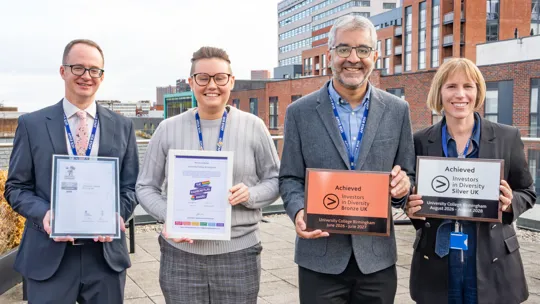
University College Birmingham strengthens its commitment to inclusion
National equality, diversity and inclusion accolades reflect our ongoing work to embed inclusion into university life.
Read more
University expands hospitality training with Beyond and Brocks
Investment programme set to transform the student experience and strengthen Birmingham's hospitality sector.
Read more
Hospitality and tourism conference inspires students to step up to Invictus Games
University College Birmingham students got a glimpse of how they could be part of one of the world's most ins…
Read more
University's first social work apprentices begin their studies
Developing the next generation of social workers and creating a learning community where apprentices feel that they belong.
Read more
University College Birmingham earns Armed Forces Covenant Silver Award
The University continues to strengthen its engagement with the Armed Forces sector.
Read more
From University College Birmingham student to Commonwealth Games silver medallist
Judo champion Max Gregory returns to campus.
Read more