
COMPUTER SCIENCE
BSc (Hons) Top-up
Accredited by University College Birmingham
- University
- Undergraduate
- Courses
- Computer Science BSc (Hons) Top-up
Award
BSc (Hons)
Duration
1 year FT
UCAS Code
G410
Entry
September
Fees
View fees

Gain a broad range of computing knowledge studying up-to-date, industry-relevant topics

£25,000 average salary in IT, with other roles paying up to £70,000
Digital technology and computers have become essential for modern-day living, driving everything from the economy and finance to communication and leisure. If you are keen to advance your existing skills and knowledge in this field, our Computer Science top-up degree course will enable you to stay up-to-date with the latest information technology developments in preparation to make your impact on the industry.
Designed for anyone who has previously studied a relevant subject (up to Level 5), this course explores a range of key topics including mobile computing, artificial intelligence (AI) and Agile software development, while you will also have the chance to explore an area of computer science in depth for your final research project.
Throughout our Computer Science top-up course, you will have access to our state-of-the-art IT and computer facilities, including our Cyber Security Lab. On completion, the doors are open for you to pursue careers ranging from systems analysis to web or software development and more, as well as the opportunity to progress onto postgraduate level study such as our Computer Science master’s course.
Why should I choose to study Computer Science BSc (Hons) Top-up?
- PRACTICAL APPLICATION – Learn in our purpose-built computer labs including our Cyber Security Lab on campus
- IN-DEPTH RESEARCH – Take on a substantial research project exploring an aspect of computing science in depth
- AWARD-WINNING UNIVERSITY – Study at the highest-ranking university in the region according to student choice (Whatuni Student Choice Awards 2023)
Our facilities
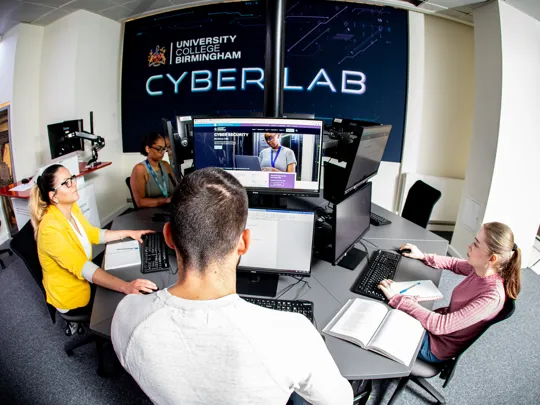
Students on our computing university course will have access to computer labs specifically designed for this degree, while our new cyber security laboratory will enable students to learn and participate in cyber-related activities in a controlled environment.

Our Cyber Security Lab provides a controlled environment for students to learn and participate in cyber-related activities

Located in Camden House, the Cyber Security Lab enables students to experiment and experience a range of cyber security scenarios safely using a discrete network
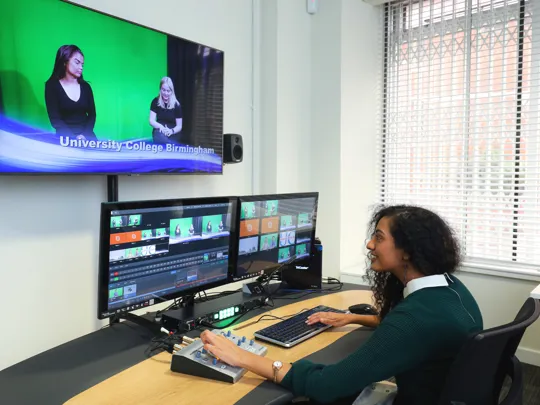
Based in Camden House, our computing facilities contain dedicated teaching labs complete with high-spec computers and industry-standard software
Course breakdown
- Modules
Core Modules
Agile Software Development
The module studies in detail the activities associated with software development process as performed by a development team that adopts an Agile methodology. Topics covered include the concepts, principles, practice and philosophy of an Agile approach to software development. Students will work in groups to learn about collaboration: environment, programmer collaboration, team values, customer involvement, standards and reporting. The module covers planning, release, risk assessment and estimating. It also considers agile development: incremental requirements, customer tests, test-driven development, refactoring, simple design, incremental design and architecture, spike solutions and performance optimisation. Students will learn to manage agile projects: roles, values and team philosophy; management of scope and the business/economic issues such as time, cost, quality and risk.
Artificial Intelligence
The module will introduce the field of artificial intelligence and study the principal ideas and techniques in key topic areas including problem solving, knowledge representation and machine learning. The module will cover problem solving (problem representation, uninformed and informed search), knowledge representation (logic-based languages, e.g. description logic, and ontologies and the semantic web) and machine learning (symbolic learning, decision trees and Bayesian learning).
Final Year Project
This module will provide an opportunity for you to conduct research into an unfamiliar aspect of Computing Science and enable you to develop and apply computing skills to a substantial problem. You will synthesise what you have learned from other modules and be provided with an opportunity to work independently.
Mobile Computing
This module covers the integration of network flexibility into the architecture and policies of a commercial network. It looks at the issues related to the security and productivity linked to the deployment of a BOYD policy and in the use of diverse integrated delivery models.
Professional Issues in the Computing Sector
The purpose of this module is to bring together material in the key areas of professionalism and careers, finance, health and safety, environmental concerns, law and intellectual property, in the context of the software industry. You will apply relevant computing-related legislation and professional codes of conduct to day-to-day situations that arise in business, and evaluate risks associated with those situations. You will also explain your five-year career plan and know what steps need to be taken to achieve it.
The modules listed above for this course are regularly reviewed to ensure they are up to date and informed by industry as well as the latest teaching methods. On occasion, we may need to make unexpected changes to modules – if this occurs, we will contact all offer holders as soon as possible.
Entry requirements
Entry requirements
Academic: A relevant HND or a foundation degree in the area of computer science, with 240 credits.
If you are unsure if your previous qualification is suitable, please contact us before completing an application. You can call us on 0121 604 1040 or complete our enquiry form here.
International students
Academic: European and International qualifications studied in a relevant subject matter will also be considered. Applicants will need to have achieved 120 ECTS or equivalent (European Credit Transfer).
If you are unsure if your previous qualification is suitable, please contact us before completing an application. You can call us on 0121 604 1040 or complete our enquiry form:
Key information
Teaching and assessment
Note: Indicative information only – actual timetables and assessment regimes will be issued at your induction.
Teaching
Example of a typical teaching week (up to 14 contact hours):
- Group teaching– 6 hours
- Subject related workshops – 6 hours
- Tutorials– 2 hours
You will also need to commit around 20 hours per week for individual study time.
Assessment
Estimated breakdown of assessment for this degree course:
- Coursework– 50%
- Practical assessment / projects– 50%
Our teaching and assessment is underpinned by our Learning and Teaching Strategy 2025-2030.
Tuition fees for home students
If you are a home student enrolling on a bachelor's or foundation degree course at University College Birmingham, the 2025/2026 academic year tuition fee for full-time study is £9,535. For part-time study, the fee is £4,767.50.
Kick-Start Scheme
As a new student studying this course full-time, you will receive £300 per year through our Kick-Start Scheme (UK students only, eligibility criteria applies). This scheme will support your studies and future career by contributing to course-related materials, uniform or selected items on campus. You may also qualify for an additional £500 per year.
Find out more about the Kick-Start Scheme here.
Unibuddy Community - meet other students on your course
Starting university is an exciting time, but we understand that it can sometimes feel a little daunting. To support you, you will be invited to join our Unibuddy Community, where you can meet other students who have applied for the same course at University College Birmingham, before you start studying here.
As soon as you have been made an offer, you will be sent an invitation email to complete your registration and join the Unibuddy Community. For more information, check out our Unibuddy Community page.

This course is delivered in partnership with the Greater Birmingham and Solihull Institute of Technology (GBSIoT).
Accreditations, endorsements and partnerships
University College Birmingham works with a wide range of organisations to ensure you receive the best possible training and qualifications recognised by industry.
Computing was recently placed as the number one most frequently required role for graduates, and the sector is also one of the best paid for graduates. This course has been carefully researched to ensure subjects are current and relevant to the current IT sector job market.
Edward Bird Deputy Dean
Career opportunities
The example roles and salaries below are intended as a guide only.
Software developer
Average Salary: £31,000
Systems analyst
Average salary: £30,000 – £40,000
Database administrator (DBA)
Average Salary: £30,000
IT technical support officer
Average Salary: £28,000
Computer security consultant
Average Salary: £44,000
Web developer
Average Salary: £26,000
Want to take your studies to the next level? Completing the BSc (Hons) degree will enable you to move onto our postgraduate courses such as Computer Science MSc/PGDip or Enterprise Management MSc/PGDip.

Ed's Story
Ed, who has a background in software development and managing computing departments, discusses the standout features of our computing degree.
Meet your lecturers


Other courses you may like
Computer Science BSc (Hons) / FdSc
Open the doors to a future in the modern world of technology. Our Computer Science degree lets you explore the latest cutting-edge topics in the computing industry and will help you become confident with everything from networks and databases to programming and cyber security.
Cyber Security BSc (Hons) / FdSc
Become part of the fight against cyber attacks and cyber crime by taking this cutting-edge course. Our degree will give you key cyber security skills and up-to-date knowledge in a range of technical areas, applying your training in our cyber security laboratory and on placement.
Electromechanical Engineering BEng
The world is crying out for skilled engineers and our Electromechanical Engineering BEng degree will give you all the key disciplines – essential math's, mechanical and electrical science, electronics, design and programming, learning in Industry 4.0 facilities.
Marketing BA (Hons) / FdA
Master the marketing profession by studying our Marketing degree course. Featuring live projects, guest lectures, an overseas residential visit and the option of a paid work placement, this course will give you the tools to thrive in this dynamic field.
Digital Marketing BA (Hons) Top-up
‘Top up’ your existing qualifications for a full BA (Hons) degree on our one-year Digital Marketing course. Expand your skill set through working on live digital marketing and consultancy projects as well as networking with agencies and hearing from top industry experts.
