Why should I choose to study Building Services Engineering HNC?
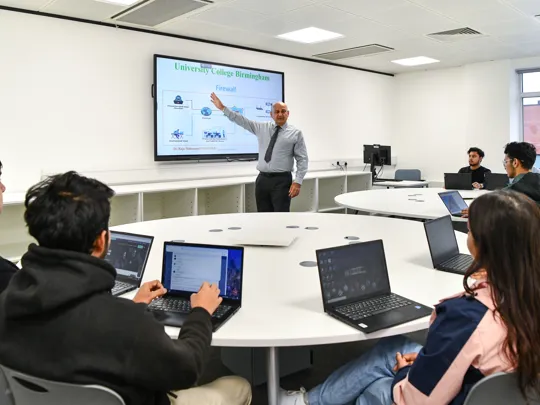
- EXPERT TUITION – Learn from our highly-qualified staff with extensive practical knowledge of construction - supported by expert guest lecturers
- MODERN METHODS – There is a firm focus on sustainability and health and safety to meet the demands of the future
- PRACTICAL APPLICATION – Get hands-on experience studying in our cutting-edge construction facilities with design units in electrical and HVAC
- NO EXAMS - If you are not keen on exams, this course is for you. Unlike many degrees in this field, you will have no written exams during or at the end of the course and will be assessed through coursework only
- AWARD-WINNING UNIVERSITY – Study at the highest-ranking university in the region according to student choice (Whatuni Student Choice Awards 2023)
Our facilities
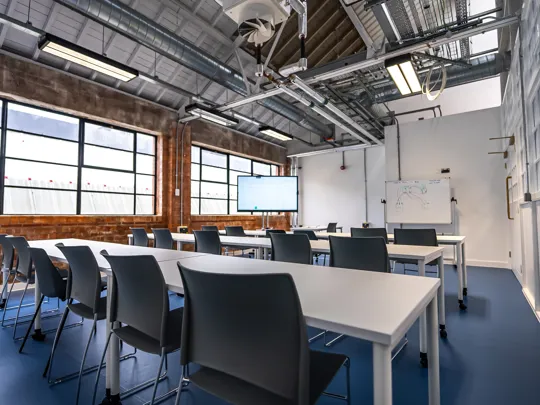
Students on our construction and engineering courses learn in brand new real-world training environments. Our Sustainable Construction Skills Centre at the iconic James Cond Building offers state-of-the-art facilities specifically designed to develop skills that support employers and their supply chains, along with further specialist facilities for design and IT skills at Camden House. Facilities include:
- Design studios with industry standard CAD software (AutoCAD and Revit)
- 3D printers and plotters
- Renewable energy simulators
- Hydraulics test equipment
- Production line technology
- Human comfort surveying tools
- Control engineering rigs
- Cyber physical system
- Mechatronics automation
- PLCs
- Fluid dynamics software
- Enhanced IT facilities
Course breakdown
- Year 1
Core Modules
Construction Design Project
The success of any project relies on the development of a good design and the provision of technical information to enable the project to be built. The aim of this module is to help you appreciate and be aware of the design process, as well as the information required to communicate the design itself, specify and quantify materials, and provide instructions for assembly and construction. As well as facilitate precise costing and project management.
Digital Applications for Building Information Modelling
Building Information Modelling (BIM) is a crucial tool for managing projects throughout their lifecycle, enhancing efficiency, reducing costs, and driving sustainability. It relies on digital applications to generate project data, which is central to designing and producing information for construction and operation. This module aims to explore key processes in using digital applications for BIM, enabling you to achieve vendor certification in industry-standard systems.
Mathematics for Construction
This module aims to enhance your understanding of mathematical principles and theories in construction technology, structures, and materials. It covers topics like trigonometry, algebraic techniques, matrices, statistical techniques, differential calculus, binomial distribution, dimensional analysis, arithmetic progressions, and vector analysis. Successful completion will equip you with critical thinking, problem-solving, analysis, reasoning, and data interpretation skills.
Principles of Alternative Energy
Buildings consume 40% of global energy, 25% of water, and 40% of resources. Governments worldwide have implemented legislation to address energy consumption in the built environment, often with financial incentives for alternative energy systems. Solar, wind, and hydro energy technologies are now established and are often incorporated into construction projects. This module aims to develop your knowledge of energy technologies, enabling you to research and design alternative energy systems.
Principles of Electrical Design and Installation
Electricity has been studied since the 17th century, but the 20th century saw the rapid expansion of electrical devices and installations. This module aims to teach you about electrical machines, distribution of electric energy, and lighting design basics, enabling you to design simple installations in compliance with relevant legislation and standards.
Principles of Heating, Ventilation and Air Conditioning
This module teaches you about designing and installing heating, ventilation, and air conditioning systems for non-domestic buildings. It covers key calculations, sizing, and specifications of these systems, which are crucial for maintaining comfort and managing environmental impact. It also covers stringent emission targets.
Scientific Principles for Building Services
This module teaches you the application of scientific principles in building services engineering, covering areas like heat transfer, fluid flow, acoustics, electrical networks, and control systems. It aims to provide a foundation in understanding the relationship between building services and human comfort, enabling you to design and specify building services effectively.
The Construction Environment
Construction is a complex and dynamic sector of the local, regional, national and international economy. In many countries, it is a driving force in the growth of finance, property and employment. This also means that it has a considerable impact on many factors beyond its direct influence on the buildings and infrastructure that are created and maintained. The construction industry is one of the major contributors to CO2 emissions. Also, the way that buildings are designed, constructed and maintained means they have an ongoing impact on the environment. Similarly, as a major employer, the industry has an ongoing impact on the working conditions of those in the sector and the way that people are educated, trained and supported through their careers.
The modules listed above for this course are regularly reviewed to ensure they are up to date and informed by industry as well as the latest teaching methods. On occasion, we may need to make unexpected changes to modules – if this occurs, we will contact all offer holders as soon as possible.
Entry requirements
Entry requirements
A-levels: An A-level grade profile of EE.
T-levels: A T-level graded Pass with a core component profile less than C.
BTEC: A BTEC grade profile of PP. This can be achieved from either an Extended Diploma or a combination of smaller BTEC qualifications.
Apprenticeship: Achieve an advanced apprenticeship (Level 3).
Tariff: Other Level 3 qualifications are accepted for entry. A minimum of 32 UCAS Tariff points will be required.
Access to Higher Education Diploma: 32 UCAS Tariff points.
Non-tariff: Non-UCAS Tariff-based Level 3 qualifications are also considered for entry.
GCSEs: You should also have a minimum grade 4 in GCSE Mathematics, or Functional Skills Level 2.
Work-based: We also give equal consideration to applicants who are currently in work and wish to apply to University College Birmingham. To apply, you must have a minimum of 3 years’ relevant work experience, demonstrating management or supervisory duties. Your application must also include a reference from your line manager supporting your entry to higher education. For further details, please contact Admissions.
Key information
Teaching and assessment
Teaching
A wide variety of teaching methods will be used to ensure you gain the appropriate skills and knowledge, including lectures, practical sessions, workshops, tutorials and group study sessions. Face-to-face classes will be combined with practical research activities in our state-of-the-art construction facilities, while you will also conduct independent and online learning.
Assessment
Assessment occurs through a combination of assignments and projects with a focus on the holistic development of practical, interpersonal and higher-level skills. Many modules will require a demonstration of skills, while others will require you to carry out your own research and analysis, working independently or as part of a team.
Our assessments will focus on developing the skills required by a professional building services engineer – designing and demonstrating a building system, delivering presentations and technical report writing aimed at technical and non-technical audiences to broaden your range of skills.
You will also need to commit around 20 hours per week for individual study time.
Assessment for this course will be 100% coursework.
Our teaching and assessment is underpinned by our Learning and Teaching Strategy 2025-2030.
Timetable
We understand that you need to balance study with work, so your lessons will be timetabled into one day a week for part-time study.
Tuition fees for home students
If you are a home student or an EU student with settled/pre-settled status enrolling on a full-time HNC in 2025/2026, your fee for this academic year will be £9,535. UK students do not pay tuition fees for any placement periods.
For part-time study, the fees would be £4,767.50 per full year of the programme.
Unibuddy Community - meet other students on your course
Starting university is an exciting time, but we understand that it can sometimes feel a little daunting. To support you, you will be invited to join our Unibuddy Community, where you can meet other students who have applied for the same course at University College Birmingham, before you start studying here.
As soon as you have been made an offer, you will be sent an invitation email to complete your registration and join the Unibuddy Community. For more information, check out our Unibuddy Community page.
Accreditations, endorsements and partnerships
University College Birmingham works with a wide range of organisations to ensure you receive the best possible training and qualifications recognised by industry.
Career opportunities
The example roles and salaries below are intended as a guide only.
Building Services Technician
Average Salary: £30,000
Building Services Engineer
Average Salary: £35,000
Intermediate Electrical Engineer (Building Services)
Average Salary: £38,000
Intermediate Mechanical Design Engineer (Building Services)
Average Salary: £35,000
Want to continue your studies? Completing this HNC will give you the opportunity to move onto the second year of the Construction Management BSc (Hons) course.

Rachael’s Story
Senior engineering lecturer Rachael has witnessed first-hand the rapid changes in industry and is now sharing her vast experience with our students.