of graduate employers say relevant experience is essential to getting a job with them

- University
- Postgraduate
- Courses
- Data Analytics MSc
Award
MSc
Duration
1.5 years FT / 2.5 years PT
Placement
FT only - 3 or 6 months (optional)
Entry
September, February
Fees
View fees

Salaries for this area can range from £20,000 up £60,000 per annum*
*National Career Service

The data analytics market size is projected to grow from $7.03 billion in 2023 to $303.4 billion in 2030
Data is the cornerstone of innovation and strategy across all industries in today's dynamic business landscape. Whether you're fascinated by numbers or passionate about problem-solving, this program equips you with the tools to unlock actionable insights from complex data sets.
Our multidisciplinary approach combines mathematics, statistics, and computer science to delve into the world of data analytics. From understanding the fundamentals to mastering advanced techniques, you'll explore everything from data collection to storage frameworks.
Throughout the programme, you'll learn how to use data mining tools and big data applications, alongside essential data analysis software. By honing your data interpretation and application skills, you'll be prepared to drive meaningful change and solve real-world business challenges.
Opportunities to gain practical skills and experience are built into our Data Analytics master's course, from studying in our computer labs and other IT facilities on campus to learning from sector expert lecturers. By completing the course, you can open the doors to careers in anything from software and web development to market researcher, systems or finance analyst, opening up a wealth of possibilities for your future in this field and making you a valuable asset for today's data-driven world.

Why should I choose to study Data Analytics MSc?
- PRACTICAL APPLICATION – Develop your practical computing skills in our excellent IT facilities, including a dedicated Cyber Security Lab
- WORK PLACEMENT (full-time MSc only) – Complete an optional three-month or six-month placement in the IT sector to boost your experience and industry connections on successful completion of the taught part of the course
- IN-DEPTH RESEARCH – Explore a topic within computing and technology in depth by conducting your own master’s research project
- NO EXAMS - If you are not keen on exams, this course is for you. Unlike many degrees in this field, you will have no written exams during or at the end of the course and will be assessed through practical assessments and coursework only
- STUDENT SATISFACTION – We scored an overall positivity score of 88% in the 2025 Postgraduate Taught Experience Survey (PTES), 2% higher than the sector benchmark. We also came 9th out of 102 institutions for postgraduate support and 8th for community
Lorem ipsum dolor sit amet, consectetur adipiscing elit. Nunc mi nisl, volutpat ut vestibulum eu, ornare ac ligula. Etiam id dolor non nisl consectetur tincidunt. Donec quis leo ut nisi commodo maximus. Pellentesque a purus nulla. Pellentesque gravida tortor elit, a convallis sapien molestie nec. Mauris nec aliquet sapien. Nunc blandit urna turpis, ut porta ante interdum at. Fusce aliquet sapien et dignissim faucibus. Sed id convallis enim, nec sodales dolor.
Our facilities
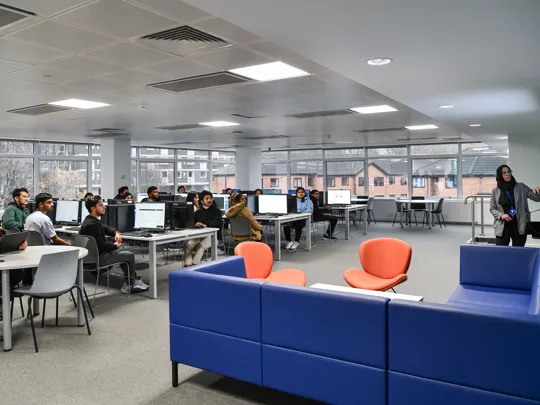
As a student on a postgraduate computing course, you will have access to cutting-edge IT facilities on campus.

Based in Camden House, our computer facilities contain the hardware and software required for industry.

Based in our Camden House, our smaller computing classrooms are ideal for group work and allow lecturers to offer more one-to-one support.
Course breakdown
- Postgraduate
Core Modules
Principles of Data Analytics
This module will immerse you in the foundational principles and practical applications of data analytics, essential for success in today's data-driven industries. You will develop a comprehensive understanding of core data analytics concepts and techniques, build your skills to extract valuable insights from complex datasets and drive data-informed decision-making. This module is designed to equip you with the essential skills and knowledge needed to excel in the rapidly evolving field of data analytics. Over 12 weeks, you will comprehensively explore data analytics methodologies, tools, and best practices, focusing on addressing real-world challenges and opportunities.
Data Visualisation
This module will teach you to transform raw data into impactful visualisations grounded in the latest research and industry practices. You will gain hands-on experience with cutting-edge tools and learn to design visually striking, meaningful data representations that reveal patterns, identify trends, and communicate findings effectively. You will align visualisation strategies with business objectives through real-world case studies across various industries. Upon completion, you will be a versatile data visualisation specialist, ready to drive innovation and redefine data storytelling in any organisation.
Data Analytics Methods and Tools
This module introduces and develops essential development tools and coding skills for analysing and interpreting data. This module covers programming tools and skills, particularly in applications for data analytics, utilising data structures, design patterns, and relevant programming libraries. You will also work on hands-on projects to apply programming concepts in real-world scenarios and integrate them with databases and big data platforms. Suitable for both beginners and advanced users, this module is essential for building effective data science applications and acquiring practical, industry-relevant skills.
Statistics for Decision Making
In this module, you will use statistical learning strategies and methodologies to gain knowledge of statistical data analysis to create and test hypotheses. You will also learn to make practical decisions in analytics through related concepts and methods. The module supports basic and advanced statistical tests and integrates seamlessly with various data sources. This module is essential for transforming raw data into actionable insights, enabling users to make informed, data-driven decisions effectively.
Applied Data Mining
This module introduces the core data mining concepts, techniques, algorithms, research issues and practical skills for applying data mining techniques to solve real-world problems. The module covers the knowledge discovery process, involving data mining and pre-processing and post-processing steps. It also focuses on the concepts of data mining applications and further aims to develop skills in data mining tools to evaluate the quality of the discovered knowledge.
Data Analytics Research Methods
This module aims to develop students’ knowledge and competence of the research process and the application of research methods in Data Analytics. It covers an introduction to qualitative, quantitative, and mixed-method research and considers the contexts within which different methods are useful and how they should be applied in practice. It focuses on research design, data collection and analysis, and the presentation of findings.
Data Analytics Masters Research Project
This module introduces students to the disciplines and techniques necessary for critically appraising complex data and industry practices. It also covers the key skills needed to successfully complete a research project, ranging from developing a research approach, setting research aims and objectives, critically reviewing existing literature, evaluating appropriate methodologies, and analysing research data and information. The module will develop students' skills and expertise in the essential research tools they need for successful Postgraduate study and as leaders in their chosen service industry sector.
Data Analytics Capstone Project
This module will help you transform your data analytics skills into real-world impact. The Data Analytics Capstone Project module offers you an exciting opportunity to undertake a major project that will consolidate everything you have learned in the taught programme. This module is not just about theory; it is about putting your knowledge into practice. You will plan and work on a significant data analytics project, developing independent learning skills along the way. You will have the chance to apply your creativity and problem-solving abilities to real-world challenges or client briefs, as you work to meet their needs and innovate solutions. You will be encouraged to manage all aspects of your project, including planning, developing project documentation, and managing activities, learning to work within practical contexts. You will also sharpen your communication skills, learning to effectively engage with stakeholders, present your findings, and produce clear and concise project documentation. Through a reflective report, you will evaluate the success of your project, providing an opportunity to appraise your strengths and areas for development. This capstone project is designed to boost your confidence, enhance your skills, and develop your leadership potential, preparing you for a successful career in data analytics. This module will prepare you to become a data analytics professional who can develop robust solutions by thinking creatively, managing projects effectively, and engaging with stakeholders.
Work Placement (optional - full-time MSc only)
Postgraduate Work Placement (optional)
The Postgraduate Work Placement module provides you with the opportunities to further develop practical skills, relate theory to practice and to gain a sound base of experience. In addition, the module seeks to develop 'life skills' to assist you in progressing towards a career in management. The placement period offers you the opportunity to experience work in industry. Your needs and any previous experience are taken into consideration, when supporting you in your placement search.
The modules listed above for this course are regularly reviewed to ensure they are up to date and informed by industry as well as the latest teaching methods. On occasion, we may need to make unexpected changes to modules – if this occurs, we will contact all offer holders as soon as possible.
Entry requirements
Academic
- MSc Data Analytics – A grade classification of 2:2 in a relevant degree is required, or international equivalent. A relevant degree can be in Computer Science, Data Science, Artificial Intelligence, Information Technology, or Software Engineering.
- Other Relevant Degrees, which may require additional learning in coding or mathematics, include Mathematics, Statistics, Business, and Engineering.
- A relevant UK or International honours degree from a recognised institution.
Work-based
- We also consider applicants who are currently employed and wish to apply to University College Birmingham.
- To apply, you must have five years of relevant managerial work experience, demonstrating in-depth knowledge of the sector for the subject matter you are interested in pursuing.
- A reference detailing your roles and responsibilities from your line manager and a meeting with the programme team will usually be scheduled prior to a place being offered.
International students
For academic and English entry requirements for EU and international students, please visit the Country Specific Information page.
Please note: As an International Student, when choosing optional placement, a visa extension may be required.
Additional
If you have any questions, please complete our enquiry form:
Key information
Teaching and assessment
Note: Indicative information only – actual timetables and assessment regimes will be issued at your induction.
Teaching
Example of a typical teaching week (up to 12 contact hours):
- Large group teaching – 10 hours (in lecture rooms/specialist facilities)
- Smaller group teaching – 1 hour
- Tutorials – 1 hour
- Subject advice sessions – 1-3 hours
You will also need to commit around 20 hours per week for individual study time.
Assessment
Estimated breakdown of assessment for this course:
- Coursework – 100%
Please note that while assessments are coursework-based, most of the assignments typically involve the creation of a practical artefact (e.g., a development project or similar) alongside a written report. In some modules, coursework may also include a presentation component.
Our teaching and assessment is underpinned by our Learning and Teaching Strategy 2025-2030.
Timetable
This is an example timetable for this course. Please note that timetables can vary from year over year and semester over semester due to various factors.
Tuition fees for home students
If you are a home student enrolling on a [Band 1] postgraduate degree course at University College Birmingham in 2025/2026, the tuition fee for full-time study will be £9,500 per year. For part-time study, the fee will be £4,750 per year.
Tuition fees for international students
If you are an international student (or have been fee assessed as an international fee payer) and enrolling on a full-time [Band 1] postgraduate degree course in 2025/2026, the fee for the academic year will be £17,000. If you complete a placement year, there will be an administration fee of £500 for a full year or £250 for a half-year placement.
Unibuddy Community - meet other students on your course
Starting university is an exciting time, but we understand that it can sometimes feel a little daunting. To support you, you will be invited to join our Unibuddy Community, where you can meet other students who have applied for the same course at University College Birmingham, before you start studying here.
As soon as you have been made an offer, you will be sent an invitation email to complete your registration and join the Unibuddy Community. For more information, check out our Unibuddy Community page.
Work placements
Work placements are vital for gaining real-life experience and for building your confidence and skills before you finish your course – and they may even lead to a job when you graduate.
Our MSc Data Analytics course features the option of a three-month or six-month placement on successful completion of the taught part of the course. You are required to secure your own placement with the support of our experienced HIRED team.
Career opportunities
The example roles and salaries below are intended as a guide only.
Systems analyst
Average salary: £30,000 – £40,000
Web developer
Average Salary: £26,000
Data analyst
Average Salary: £32,500
Business data analyst
Average Salary: £40,000
Finance analyst
Average Salary: £60,000
Market researcher
Average Salary: £30,000

Ed’s Story
With a background in both business and technology, Ed knows all about the benefits of a postgraduate computing qualification – having completed one himself.

Other courses you may like
Enterprise Management MSc / PGDip
Our Enterprise Management postgraduate course will equip you with the business knowledge and experience to advance in management positions within the enterprise service sector, with opportunities to engage with entrepreneurs.
Finance and Accounting MSc / PGDip
Gain advanced knowledge of today’s complex global financial environment on our Finance and Accounting postgraduate course. Study in our state-of-the-art Financial Trading Suite and engage with real-world business problems, with opportunities to apply for exemptions from professional exams upon graduation.
Marketing Management for Events, Hospitality and Tourism MA / PGDip
This postgraduate course enables you to develop the specialist skills and knowledge to start a marketing career within the events, hospitality and tourism sectors. You will work alongside entrepreneurs on live projects.
Computer Science MSc / PGDip
Start up an advanced career in the digital and IT sector with our postgraduate computing course. Learning in cutting-edge facilities, you will study everything from AI and human-computer interaction to object-oriented programming, web development and more, with the option of a 12-week industry placement.