of graduate employers say relevant experience is essential to getting a job with them

DESIGN AND DEVELOPMENT FOR ENGINEERING AND MANUFACTURING T-LEVEL
Level 3 T-level Technical Qualification in Design and Development for Engineering and Manufacturing
- College and sixth form
- College
- Courses
- Design and Development for Engineering and Manufacturing T-level
Course Level
Level 3
Duration
2 years FT
Placement
45 days
Entry
September
Fees
View fees

Get an industry-recognised qualification equivalent to three A-levels

Clear route to progress into a skilled career or university study
Do you want to be part of the next generation of engineers? The sector is currently facing a major shortage of skilled workers in the UK, with hundreds of thousands needed to join the workforce within the next five years. If you are interested in the areas of engineering, design, manufacturing or electronics, our T-level Design and Development for Engineering and Manufacturing course will equip you with the essentials for a fantastic future career.
University College Birmingham is one of the first colleges in the UK to offer the new T-level qualification, which combines learning in the classroom with gaining vital ‘on-the-job’ experience. This two-year course will introduce you to fundamental engineering principles before enabling you to specialise in either mechanical or electrical and electronic engineering. In each case you will explore design processes, essential tools and materials, drawings, developing models and testing prototypes, as well as gaining a firm grounding in the essential maths and science relevant to the industry.
Equivalent to three A-levels, this course will help you boost your employment prospects by gaining extensive experience on a work placement in a real-world environment, supported by experts in our Hired employability team. By completing this industry recognised qualification, you could move towards careers in engineering and manufacturing repair, maintenance and installation, or you could progress onto an apprenticeship or higher education course.
Why choose this college course?
- BOOST YOUR SKILLS – Build key skills and knowledge related to engineering and manufacturing, as well as enhancing your English, maths and digital skills
- SPECIALISE YOUR STUDIES – Choose between studying mechanical engineering or electrical/electronic engineering in your second year
- WORK PLACEMENT – Get to know the world of work and gain essential industry experience through a work placement
- RECOGNISED QUALIFICATION – Our T-level course has been designed in collaboration with industry to ensure your skills meet employers’ needs and expectations
Our facilities
Students on our construction and engineering courses will learn in brand new, real-world training environments at University College Birmingham. Our Centre for Sustainable Construction at the iconic James Cond building will offer state-of-the-art facilities specifically designed to develop skills that support employers and their supply chains, along with further new facilities at Camden House. These will include:
- Training rigs
- Production line technology
- Industry 4.0 rigs
- Process manufacturing training equipment
- Hydraulics
- Pneumatics
- Renewable energy simulators
- Control engineering rigs
- Cyber physical system
- Mechatronics automation
- PLCs
- Fluid dynamics software
- MATLAB design software
- Enhanced IT facilities

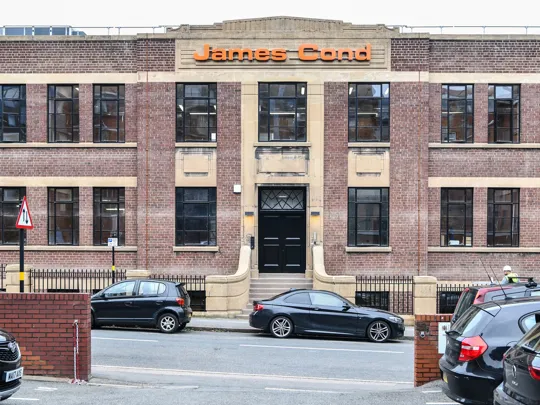
Formerly the James Cond print works, this retrofitted building is now our Centre for Sustainable Construction.
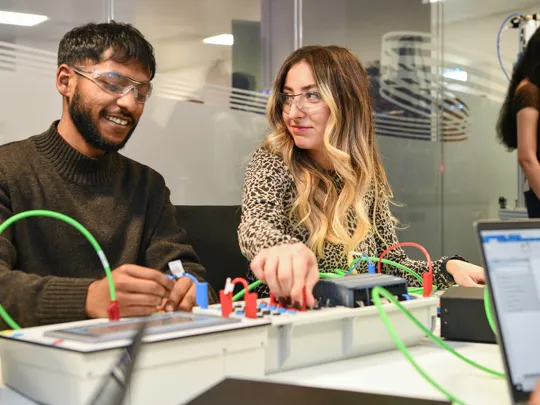
State-of-the-art facilities specifically designed to develop skills that support employers.
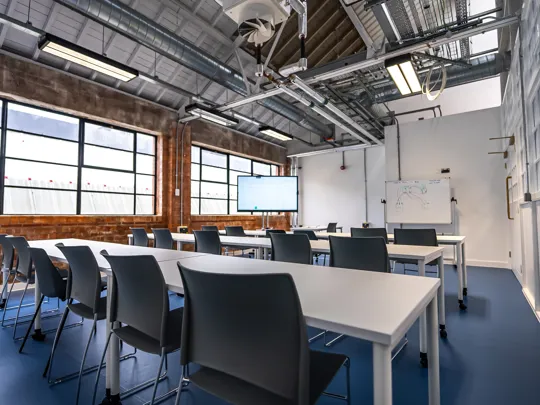
Study in one of many modern classroom spaces across our James Cond and Camden House campuses.
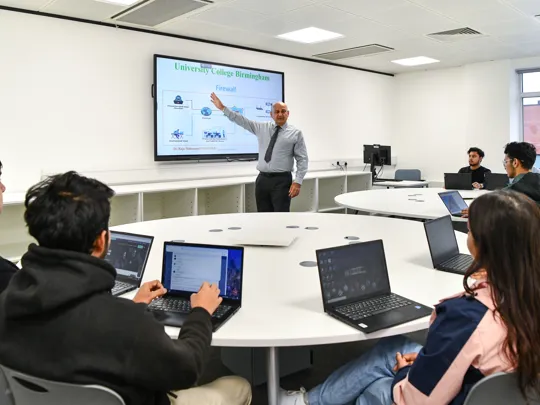
Enhanced IT facilities to support you alongside your practical training.

Course breakdown
Topics you will study:
Year 1
Core Component
- Working within the engineering and manufacturing sectors
- Engineering and manufacturing past, present and future
- Engineering representations
- Essential mathematics for engineering and manufacturing
- Essential science for engineering and manufacturing
- Materials and their properties
- Mechanical principles
- Electrical and electronic principles
- Mechatronics
- Engineering and manufacturing control systems
- Quality management
- Health and safety principles and coverage
- Business, commercial and financial awareness
- Professional responsibilities, attitudes and behaviours
- Stock and asset management
- Continuous improvement
- Project and programme management
Year 2
Occupational Specialism: Choose from Electrical and Electronic Engineering, Mechanical Engineering or Control and Instrumentation
Occupational Specialism: Electrical and Electronic Engineering
- Design methodologies and processes
- Tools, equipment and materials used in electrical and electronic engineering
- Representations, symbols, conventions and annotations used in electrical and electronic engineering
- Producing electrical and electronic drawings and representations
- Designing and developing working models
- Testing models and prototypes
Occupational Specialism: Mechanical Engineering
- Knowledge of design methodologies and processes
- Knowledge of the tools, equipment and materials used in mechanical engineering
- Knowledge of mathematical theories and methods used in mechanical engineering
- Skills in producing mechanical drawings and representations
- Skills in designing and developing working models
- Skills in testing models and prototypes
Occupational Specialism: Control and Instrumentation
- Knowledge of design methodologies and processes
- Knowledge of the tools, equipment and materials used in control and instrumentation
- Knowledge of mathematical theories and methods used in control and instrumentation
- Skills in producing schematics for control and representations
- Skills in designing and developing working models and systems
- Skills in testing models and prototypes
Please note: Units/topics of study are subject to change
You will also have an individual study programme to help you build the skills and experience you need to progress onto higher education or gain employment.
Entry requirements
Our engineering lecturers are looking for students who are enthusiastic and passionate about a career in manufacturing and engineering, together with a keen determination to succeed in the industry, so please contact Admissions if you do not have the specific requirements outlined below.
If you are unsure if your qualification is equivalent or if you wish to check if you meet the entry requirements for this course, please call 0121 214 2919, email feadmissions@ucb.ac.uk or use our live chat.
Academic requirements
- 5 GCSEs at grade 4 (grade C) including English (Language or Literature), or equivalent.
- GCSE Maths at grade 5.
English and maths
As applicants are required to achieve English and maths at grade 4 (grade C) or above prior to entering this course, University College Birmingham will not offer English or maths alongside this course.
Supporting documents required
School applicants will be required to provide a good school report, which must include attendance. This will be assessed in conjunction with your qualifications and application during the confirmation of your place at University College Birmingham.
Applicant criteria
As this is a 2-year study programme, you will need to be aged 16 to 18 to apply for this course.
Currently, T-level courses are only funded for learners who are under the age of 19 at the point of enrolment. However, the government is currently reviewing a T-level pathway for mature learners, which we hope will be available in the future. If you would like to apply for a related course, please consider our BTEC Level 3 National Foundation Diploma in Engineering.
Placement
T-level courses require you to complete a minimum of 315 hours (approximately 45 days) on placement over the two years. You will be required to work with our Hired team to secure your placement.
Guaranteed progression
We are continuing to develop and enhance our portfolio of engineering and construction courses with the aim of delivering undergraduate courses in the next two years. This will provide an opportunity for students who successfully complete a Level 3 qualification in these subjects to progress here at University College Birmingham. Students will be guaranteed progression to one of our relevant degree-level courses.
Key information
Teaching and assessment
You will have three days per week in college and an industry placement of at least 45 days. Around 4-6 hours of homework per week is also advised.
Staff will monitor your progress and have one-to-one meetings with you with targets set. You will also have progress reviews during your work experience, both from our staff and your employer.
Our teaching and assessment is underpinned by our Learning and Teaching Strategy 2025-2030.

This course is delivered in partnership with the Greater Birmingham and Solihull Institute of Technology (GBSIoT).
Accreditations, endorsements and partnerships
University College Birmingham works with a wide range of organisations to ensure you receive the best possible training and qualifications recognised by industry.
Work placements
Work placements offer a wealth of benefits alongside your studies, helping you put your learning into practice, develop your skills and understanding of the workplace, boost your CV for your chosen career or enhance your UCAS application for higher education. Our Hired team can help find the ideal placement for you.
Our engineering T-level course requires you to complete a minimum of 315 hours (approximately 45 days) on placement over the two years. Our employability tutors will visit you out on placement to ensure you gain the right practical skills.
Career opportunities
The roles and salaries below are intended as a guide only.
Mechanical engineer
Average Salary: £32,000
Electrical/electronics engineer
Average Salary: £32,000
Process manufacturing engineer
Average Salary: £35,000
Product designer
Average Salary: £45,000
Aspiring to a higher level career? Complete this course and you could progress onto our Engineering HND course.

Discover more about T-levels
Designed in direct collaboration with employers and businesses, T-levels are a great new route into skilled employment, further study or higher apprenticeships.

Other courses you may like
Engineering Level 3
If you aspire to work in the areas of engineering and manufacturing, this BTEC Level 3 course will equip you with skills and knowledge in everything from mathematics and materials to AI and robotics, providing ideal preparation for future careers and further study.
Engineering Level 2
Do you dream of becoming an engineer? Whether you’re interested in electronics, manufacturing or automation, our introductory engineering course will get you tooled up with the essential skills and knowledge to start your journey towards a career in this growing, fast-paced field.
Design, Surveying and Planning for Construction T-level
Want to be part of the future of sustainable construction? This T-level course is equivalent to three A-levels and will provide you with a grounding of knowledge from design to project management and more, alongside building substantial experience on work placement.
Construction and the Built Environment Level 3
Start building your career in the construction industry. Our Level 3 course will teach you the essentials such as construction mathematics, design, science and materials as well as focusing on sustainability, with a work placement to give you vital real-world experience.
Construction and the Built Environment Level 2
If you’re considering a career in construction, our Level 2 course will lay the foundations of knowledge and skills for you to start your journey in this sector, offering valuable work experience in the industry alongside your studies.
Computing and ICT Level 3
Get yourself ready for the modern-day digital world of work with our BTEC National computing college course. Learn about computer science, programming and other essential ICT skills, as well as boosting your real-world experience through work placements.
