
- Apprenticeships
- Courses
- Assistant Practitioner (Health) Apprenticeship
Award
FdSc
Course Level
Level 5
Duration
22 months
Entry
Multiple cohort entries throughout the year
90% of apprentices will remain in employment after completing their apprenticeship
83% of apprentices say their apprenticeship has improved their career prospects
The FdSc Assistant Practitioner in Healthcare (Apprenticeship Route) is a 22-month, work-based foundation degree for people already working in a health or care support role who want to become skilled, compassionate and confident Assistant Practitioners. You will work alongside registered professionals such as nurses, physiotherapists and paramedics, delivering person-centred care while you study. Entry is employer-led, so your employer supports you throughout.
Across eleven modules you will build practical clinical skills, professional values, leadership, evidence-based practice and specialist care knowledge. One 12-hour study block per fortnight, consisting of taught content and guided study, will fit around your job. Two professional practice modules focus on directed activities in your own workplace, which are recorded in a Practice Assessment Document and supported by your module lead and workplace mentor/supervisor. In Year 2, the Therapeutic Interventions module includes role-specific content, so you study what matters most in your own setting.
Assessment is authentic and varied, from reflective writing, a viva and a narrated case presentation to a digital workbook and a professional discussion based on a real patient. Early academic skills support and regular formative feedback help you succeed, whether you are new to higher education or returning after a break.
The course culminates in an end-point assessment, carried out by UCB, the successful completion of which results in achieving your apprenticeship certificate alongside your foundation degree. The qualification opens routes into Assistant Practitioner roles and further study, subject to the usual application process and eligibility requirements of the relevant programme.
Why choose this apprenticeship?
Practical and job-ready - you develop immediately usable skills such as physiological measurements, clinical assessment, risk assessment and person-centred care, applied in your own workplace through two Professional Practice modules.
Supportive and inclusive - early academic skills support, regular formative feedback and a flexible, blended pattern of one taught day every other week make the programme accessible whether you are new to higher education or returning after a break.
Relevant to your role - therapeutic Interventions includes role-specific content, so you apply pharmacology and clinical reasoning to your own scope of practice and working environment.
Employer-aligned qualification - mapped to the national Assistant Practitioner (Health) standard, with employers involved in your admissions interview and progress throughout your apprenticeship.
Our facilities
When on campus you will benefit from UCB’s state-of-the-art clinical suites, which replicate realistic hospital ward environments. These facilities allow you to practise clinical skills, physiological measurements, and scenario-based learning in a safe, authentic setting.
You will also have access to the Anatomage interactive table – a cutting-edge 3D anatomy visualisation tool that enables you to explore human body systems in incredible detail, supporting your learning in the anatomy and physiology for clinical practice module and beyond.
These specialist resources ensure you can develop confident, safe, and competent practical skills alongside your academic and professional development.

Our facilities include a replica hospital ward complete with simulation manikins and integrated filming and audio equipment

Our simulation facilities also include a community care environment, allowing you to practise working in the variety of settings you may encounter in your future career
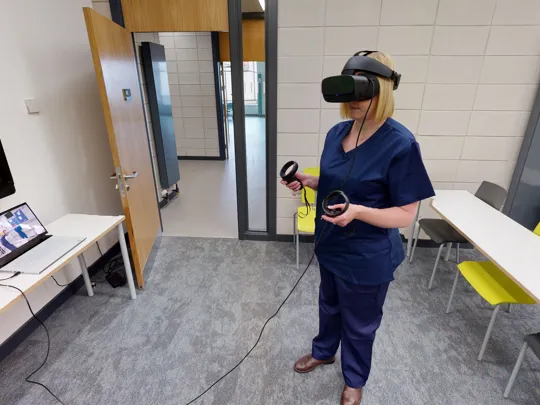
We have a clinical skills teaching room with virtual reality technology to support your training, along with additional study and teaching areas
Core Modules
- Year 1
- Year 2
Core Modules
Professionalism in Healthcare
In this module, you will explore what it means to be an Assistant Practitioner, your scope of practice, your professional responsibilities, and the codes of conduct and legislation that shape your role. You will develop your understanding of how to keep information confidential and secure, including the safe use of digital tools in your everyday practice. You will build the academic study skills you need to succeed on the programme, including how to search for and use literature effectively. Additionally, a key part of this module is developing reflective practice. You will use a named reflective model to look honestly at your own professional development needs and build strategies for your learning.
Anatomy and Physiology for Clinical Practice
In this module, you will build the anatomical and physiological knowledge that underpins everything you do in clinical practice. You will explore how the body's major systems work - including the cardiorespiratory system, the nervous system, the digestive system and the musculoskeletal system - and learn why understanding them and their functions is essential to safe, effective patient care. You will develop your understanding of homeostasis and why deviation from normal ranges matters, and you will build the numeracy skills you need to assess nutrition and hydration accurately. Your assessment tests this knowledge through a mix of short, medium and multiple-choice questions.
Principles of Assessment and Safe Practice
In this module, you will develop the legal knowledge and practical assessment skills you need to keep people safe. You will explore the law around safeguarding for both adults and children, understand how the Mental Capacity Act applies when you are working with patients whose capacity may be compromised, and learn about key aspects of the Mental Health Act that affect your practice. You will develop your skills in undertaking physiological, technical and psychological measurements, and learn to recognise when you need to escalate a concern. You will also build your understanding of risk management, duty of candour and infection prevention and control, so you can maintain a safe environment for yourself, your colleagues and the people you care for.
Person-Centred Care Across the Lifespan
In this module, you will develop your understanding of how people's health needs change throughout their lives - from before they are born to the end of life. You will explore the physiological and developmental characteristics of each life stage and learn to apply this to the patients you care for in your own clinical setting. You will explore how mental health, frailty, dementia and end-of-life care present differently at different ages, and you will build your understanding of the biopsychosocial model of health and how it underpins genuinely person-centred care. Your assessment is a narrated clinical presentation about a real patient from your own practice, which is a format that reflects how APs present clinical information in professional settings.
Healthcare in Contemporary Society
During this module, you will explore the healthcare environment, how it is organised, strategic drivers and how services operate within it to understand the sector’s unique position in contemporary society. Through varied and engaging activities, you will develop awareness of the wider determinants of health - the social, economic and environmental factors that shape a person's health - and progress your understanding of equality, diversity and inclusion to facilitate your delivery of person-centred care. You will also consider health promotion, strategy and recent research to build knowledge of approaches to addressing health issues and inequalities. You will explore sustainability and digital innovations in healthcare to gain up-to-date insight into sector priorities and developments and will integrate application of your learning to practice.
Professional Practice 1
In this module you put what you are learning in the classroom into practice in your own workplace, with structure and support from the university and your workplace mentor/practice supervisor. You complete 60 hours of directed learning activities linked to the Assistant Practitioner standard, reflect on each one with guidance from your tutor, and record your learning in your Practice Assessment Document. Three PAD stages (an introduction, a midpoint check-in and a final review) give you dedicated time with your tutor and your workplace mentor/practice supervisor to consider your progress and plan next steps. You finish the year with a Personal Development Plan that sets out your priorities for Level 5.
Core Modules
Therapeutic Interventions and Complex Conditions
In this module, you will develop the therapeutic and pharmacological knowledge that is increasingly essential to the AP role. You will start with a shared foundation in pharmacology alongside every other apprentice on the programme, before applying this to the scope of your own working environment. You will learn how to explain and justify your choice of intervention using clinical reasoning skills and knowledge of pathophysiology and complex conditions. Working with colleagues from different professions is also embedded in this module, to develop communication skills and a collaborative approach to healthcare. You will use a digital workbook to build and document your learning week by week, and you will discuss a real patient case with an assessor, justifying the approach you took and evaluating its outcome, for your summative assessment.
Evidence, Research and Quality Improvement
In this module, you will develop the skills to locate, evaluate and utilise research evidence in your clinical practice and to drive improvements in the care your team delivers. You will learn how to search healthcare databases effectively, how to read and critically appraise research papers, and how to apply the principles of evidence-based practice and the PDSA quality improvement cycle to real workplace issues. Your assessment is a quality improvement proposal, using a structured template in which you identify a genuine improvement opportunity from your own practice, review and appraise the evidence that supports it, and justify a realistic course of action.
Leadership, Communication and Developing Others
In this module, you will develop the leadership and communication skills that distinguishes a qualified AP, including the ability to lead others, manage a caseload, and communicate confidently and effectively in complex professional contexts. You will explore leadership theories and evaluate your own leadership style, applying this to an authentical scenario. You will also develop your ability to identify the learning and development needs of colleagues, and learn how to use teaching, coaching and mentoring approaches to support them. You will develop an understanding of major incident awareness and what your role would be during service pressures. Your assessment is a reflective case study including attention to your own leadership style and responsibilities, communication strategies and analysis of the development needs of others and creation of an associated development plan.
Professional Practice 2
In this module you will take their practice to the next level in their own workplace, with structure and support from the university. The apprentice will complete 60 hours of directed learning activities focused on complex care, quality improvement and leadership, reflect on each with guidance from their tutor, and record their learning in the Practice Assessment Document. Three PAD stages (an introduction, a midpoint check-in and a final review) give them dedicated time with the tutor to review their progress. They finish with a Professional Progression Statement that helps them to prepare for their end-point assessment and plan their next steps.
End-Point Assessment
This is the culmination of everything you have developed across the programme. An assessor, acting on behalf of UCB in its End-Point Assessment Organisation capacity, will observe you working in your normal clinical setting and then conduct a Professional Discussion with you about your practice and your readiness for the AP role. You will prepare a portfolio of evidence to underpin the professional discussion, which you submit in advance of the discussion itself. This assessment confirms your occupational competence following your clinical development, academic study and workplace learning.
Entry Requirements
To study the FdSc Assistant Practitioner in Healthcare (Apprenticeship Route) you must:
Be employed in an eligible healthcare or care support role that gives you scope for significant new learning, with an employer who supports your application and can release you for off-the-job training and workplace assessment.
Hold Level 2 English and Maths (for example GCSE grade 4/C or equivalent) before you start the programme.
Hold a relevant Level 3 qualification (for example a Level 3 Diploma in Health and Social Care, a T Level in Health, or equivalent), or have at least two years' relevant work experience in a healthcare or care setting. If you have neither, you can apply through Recognition of Prior Learning (RPL) by submitting a short written portfolio, which the programme team reviews case by case.
Hold, or be able to obtain, a satisfactory Enhanced DBS check, arranged through your employer.
Have the right to live and work in the UK for the full duration of the apprenticeship.
Attend an admissions interview with a member of the programme team and your employer before your place is confirmed.
Entry is employer-led, so discuss this opportunity with your line manager or employer first.
Key information
Teaching and assessment
Teaching
The programme uses a flexible, blended approach designed around the needs of working apprentices:
One 12-hour study block per fortnight, consisting of taught content and guided study, will fit around your job. Each block entails 7 hours taught content, mainly delivered online with some on-campus skills days, and 5 hours guided study utilising interactive online resources.
Each taught module runs for eight weeks, followed by an assessment week with protected time to prepare, complete your assessment and reflect.
On-campus skills days for practical skills and simulation.
Workplace learning through Professional Practice 1 and 2, each with 60 hours of directed learning activities recorded in your Practice Assessment Document and supported by your module lead and practice supervisor.
Small-group seminars, case studies, role-play, practical workshops and guest speakers from practice.
Assessment
Assessments are authentic, varied and proportionate, and reflect real Assistant Practitioner responsibilities. Across the programme you will complete:
Written work: a 2,000-word reflection; a health promotion resource with a written statement; a 2,000-word individual quality improvement proposal; a 2,000-word reflective case study applying and evaluating a leadership model; and two 1,000-word pieces, a Personal Development Plan and a Professional Progression Statement.
An online examination of 60 minutes, with multiple-choice, short-answer and medium-answer questions .
Oral and presentation assessments: a 20-minute viva , a 15-minute narrated presentation of a case study , and a 15-minute professional discussion based on a real patient case.
A digital workbook (Pass or Fail), tailored to your role.
Practice Assessment Documents (Pass or Fail), completed in your own workplace, with the safety-critical clinical competencies required to pass.
The End-Point Assessment, made up of an Observation of Practice and a Professional Discussion, assessed and graded separately.
Formative feedback is built in throughout (especially in Level 4) to support your development and confidence. The programme is aligned with the Assistant Practitioner (Health) apprenticeship standard and the requirements of the embedded FdSc qualification.
Our teaching and assessment is underpinned by our Teaching, Learning and Assessment Strategy 2015-2020.