Recent searches
You do not have any recent searches.

BUSINESS ENTERPRISE

BA (Hons) Top-up

Award

BA (Hons)

Duration

1 year FT

UCAS Code

N190

Entry

September, February

Fees

View fees

Department of Business and Enterprise

Our Enterprise Hub provides start-up support for your business ideas

13.2m employed by UK SMEs in 2019*

*Federation of Small Businesses, 2020

Standing out in today’s competitive business world demands that creative spark. Firms need individuals with not only the core industry knowledge and skills, but also the entrepreneurial spirit and ability to innovate – qualities that are all the more vital for anyone who dreams of setting up their own business.

Whether you want to advance in management positions or start your own company, our Business Enterprise top-up degree will expand upon your existing skill set to help you excel. Designed for anyone who has previously studied a relevant subject (up to Level 5), this final year top-up course gives you the chance to show your entrepreneurial edge by creating your own business plan, as well as allowing you to tailor your research towards a sector of the market that matches your career aims.

Why should I choose to study Business Enterprise BA (Hons) Top-up?

  • SPECIALISE YOUR STUDIES – From International Marketing to Freelancing, tailor your course to match your career aims through our optional modules
  • BUSINESS SUPPORT – Want to set up your own business? Get expert guidance and input from our Enterprise Hub team to make your start-up idea a reality
  • TOP LEVELS OF STUDENT SATISFACTION – More than 90% of students answered positively on questions relating to quality of teaching, support and development, representing a 2.5% increase on last year (National Student Survey 2025)

Our facilities

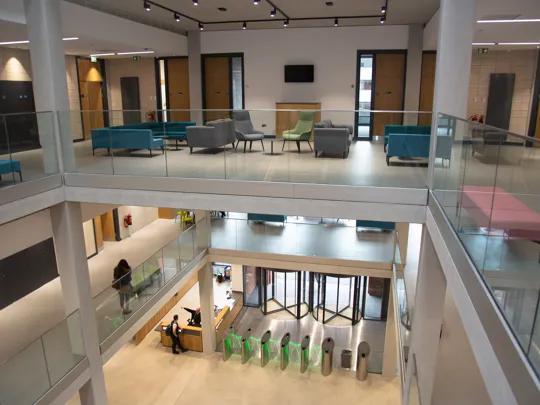
Our business courses at University College Birmingham offer students opportunities to develop practical skills. We also provide a range of support services for student entrepreneurs through our Enterprise Hub.

Course breakdown

  • Modules

Core Modules

Risk and Response Management

The underlying premise of the module is that risk taking is an entrepreneurial activity which seeks to achieve two things: the creation of value for stakeholders, and establishment of sustainable competitive advantage within the markets which businesses operate. The module examines the application of enterprise risk management techniques and the responsive strategies employed by businesses operating within increasingly complex and dynamic environments. The concept of risk is initially defined and discussed, followed by an in-depth examination of frameworks, models and techniques designed to identify, categorise, measure and manage risk.

From Incubation to Acceleration

High growth businesses are driving job creation and growth across countries. They are an increasingly critical part of the economy, making a significant contribution to economic growth and national productivity. Key features of this module include exploring scale-up indicators and drivers of acceleration, the use of data to identify and facilitate connections, engagement in peer to peer networks, understanding of investment readiness and evolving funding models.

One option from:

Venture III – Creation and Launch

This module Venture III culminates the enterprise knowledge, understanding and competencies developed through the modules Venture I and Venture II by enabling you to create and launch your business idea. These modules are a key mechanism through which you will develop the skills of independent learning, creative thinking, conceptualisation, innovation, problem-solving and value creation. The project is an individual activity performed by you through a series of underpinning lectures, workshop sessions and finally individual tutorials under the supervision of an appropriately experienced tutor. A detailed venture handbook will be produced to guide you. The showcase of students’ start-ups at an enterprise fair is intended to be of suitable quality and professionalism exhibited in an event for peers and industry professionals. Accordingly, this module is designed for students who have a foundation in venture concept development, testing and prototyping and have a clear venture concept to create and launch for Venture lll. Alternatively, students without this critical background are recommended to choose the Entrepreneurial Project instead.

Research Project

You will have the opportunity to engage in an independent research project of your choice. You will have support with preparing your proposal and understanding the competent characteristics of good research. An appointed tutor will help guide you through this important and rewarding process.

Entrepreneurial Project

This entrepreneurial project module is a key mechanism through which students develop the skills of independent learning, creative thinking, conceptualisation, innovation, problem-solving and value creation. The project affords students the opportunity to develop an entrepreneurial mindset and competencies applicable to their future career aspirations as entrepreneurs or intrapreneurs. The module context focuses on the journey toward entrepreneurial effectiveness through the development of entrepreneurial awareness, an innovative mindset, and competencies. The project requires students to undertake a critical analysis and evaluation of all appropriate data, leading to the delivery of a viable product or service.

Plus two options from:

Freelancing

A new way of doing business. Freelancing is emerging as a vessel for modern, busy people to thrive as entrepreneurs. It gives them freedom to manage multiple careers in a way that works for their life and commitments. In this module, you will develop your creativity skills, learn to 'think outside the box' and create and critically assess your own opportunities to identify tangible market potential and sustainability. In addition, you will have the opportunity to learn a range of skills including creating an on-line presence and social media as well as traditional marketing, on and offline networking, project management, influencing and negotiating skills and strategic career planning.

Financial Strategy

This module will build upon both practical and theoretical financial concepts and methods developed through earlier modules. The intention of this module is to provide an in-depth knowledge of concepts previously studied and to develop new concepts relevant to the financial operations of business. This module will be particularly useful to students who may wish to develop a career within a financial role and/or to students who wish to examine further how finance influences the short term and long term strategies of businesses.

International Marketing

We live in an interconnected world, so it's important to examine how organisations explore new market opportunities beyond national boundaries. As a result, you will become more aware of the technological, communication and transportation challenges businesses face and the options they consider when seeking a foothold in a new country.

Strategic Human Resource Management

In order to offer meaningful career pathways, what sort of strategies should a business consider? How can it meet the challenges it faces while creating an environment that retains talented employees? You will be exploring contemporary strategies in HR that shape benchmark employers in the industry.

Change and Transformation Strategy

Change is inevitable in an increasingly competitive global environment. This compels firms to proactively design strategies to deal with the resulting turbulence. This module develops an understanding of the role of leadership in conceptualising, designing and instituting effective change within organisations. The module content comprises two complementary components: the first involves the understanding and learning of the main strategic management concepts and theories, while the second implies their application in organisations. The practical orientation of the module enables students to experience the stages and activities underpinning the strategic change process.

The modules listed above for this course are regularly reviewed to ensure they are up to date and informed by industry as well as the latest teaching methods. On occasion, we may need to make unexpected changes to modules – if this occurs, we will contact all offer holders as soon as possible.

Entry requirements

Entry requirements

Academic: A relevant HND or a foundation degree in the areas of Marketing Management, Business Management, Finance and Business, with 240 credits. Or alternatively, an OTHM Level 5 Extended Diploma in Business Management or Accounting and Business.

If you are unsure if your previous qualification is suitable, please contact us before completing an application. You can call us on 0121 604 1040 or complete our enquiry form here.

Business Enterprise BA (Hons) Top-up is open for Clearing 2026

Still exploring your university options? Whether you are applying now, changing your plans or looking for a different course, you can apply to UCB through Clearing.

Apply through Clearing

Key information

Teaching and assessment

Note: Indicative information only – actual timetables and assessment regimes will be issued at your induction. 

Teaching

We won silver for our lecturing and teaching quality in the regional Whatuni Student Choice Awards 2026, as voted for by students themselves.

Example of a typical teaching week (up to 14 contact hours): 

  • Large group teaching – 5 hours 
  • Smaller group teaching – 7 hours 
  • Tutorials – 2 hours 

You will also need to commit around 20 hours per week for individual study time. 

Assessment

Estimated breakdown of assessment for this top-up course:

  • Coursework – 70%
  • Practical assessment – 22%
  • Written examinations – 8%

Our teaching and assessment is underpinned by our Learning and Teaching Strategy 2025-2030.

Additional qualifications and training

This course is accredited by the CMI, granting you a Level 5 CMI Award in Leadership when you graduate. (This is subject to payment of an additional fee.)

Tuition fees for home students

If you are a home student enrolling on a bachelor's or foundation degree course at University College Birmingham, the 2026/2027 academic year tuition fee for full-time study is £9,790. For part-time study, the fee is £4,895.

The same fee applies to those enrolling on an HNC (Higher National Certificate) or an HND (Higher National Diploma) programme. 

View tuition fees for home students

Kick-Start Scheme

As a new student studying this course full-time, you will receive £300 per year through our Kick-Start Scheme (UK students only, eligibility criteria applies). This scheme will support your studies and future career by contributing to course-related materials, uniform or selected items on campus. You may also qualify for an additional £500 per year.

Find out more about the Kick-Start Scheme here.

Percentage
70%

of graduate employers say relevant experience is essential to getting a job with them

Work experience

Work experience is vital for learning how to apply your training in the real world and for building your confidence and skills before you finish your course – and it may even lead to a job when you graduate. Our Hired team can help you find suitable work experience.

We encourage students on our BA Business Enterprise top-up course to gain work experience throughout your studies.

Work alongside experts in your sector

A snapshot of some of the employers we have worked with:

  • BMW (Germany)
  • Grant Thornton (Cambridge)
  • Westin Hilton Head Island Resort and Spa (USA)
  • Bella Italia (Birmingham)
  • Top Cashback (Stafford)

My favourite module was Innovation, Creativity and Entrepreneurship. This allowed me to use my creativity to find solutions for real business problems. We also had the opportunity to go on a trip to the Czech Republic to visit the companies we had been consulting for on the live case assignment.

Prince Alayo Business Enterprise BA (Hons)

Career opportunities

The example roles and salaries below are intended as a guide only.

Business development manager

Average Salary: £42,500

Business owner

Variable

Product manager (postgraduate)

Average Salary: £47,500

Management consultant

Average Salary: £50,000

Business adviser

Average Salary: £32,500

Sales executive

Average Salary: £34,000

Want to take your studies to the next level? Completing the BA (Hons) degree will enable you to move onto our postgraduate courses such as Enterprise Management MSc/PGDip or Finance and Accounting MSc/PGDip

Hired

We are here to support your career goals every step of the way. 


Find out more

Sven’s Story

Since receiving his first class degree, Sven has been busy driving diverse projects on a German car giant’s graduate scheme.


Read Story

Take the next step...


Back to top